
April 1-April 6, 2024
Empathy begins with a story
Join us for our Spring 2024 ArtsFest Empathy Lab as we amplify the narratives of nurses of color, shedding light on personal encounters with racial discrimination and xenophobia in the workplace. Through their stories, we hope to bridge divides, foster connection, and nurture deeper compassion within our community.
If you didn’t get a chance to join us in February, when we originally launched this lab, you have another opportunity during the first week of April during Wilson’s ArtsFest!
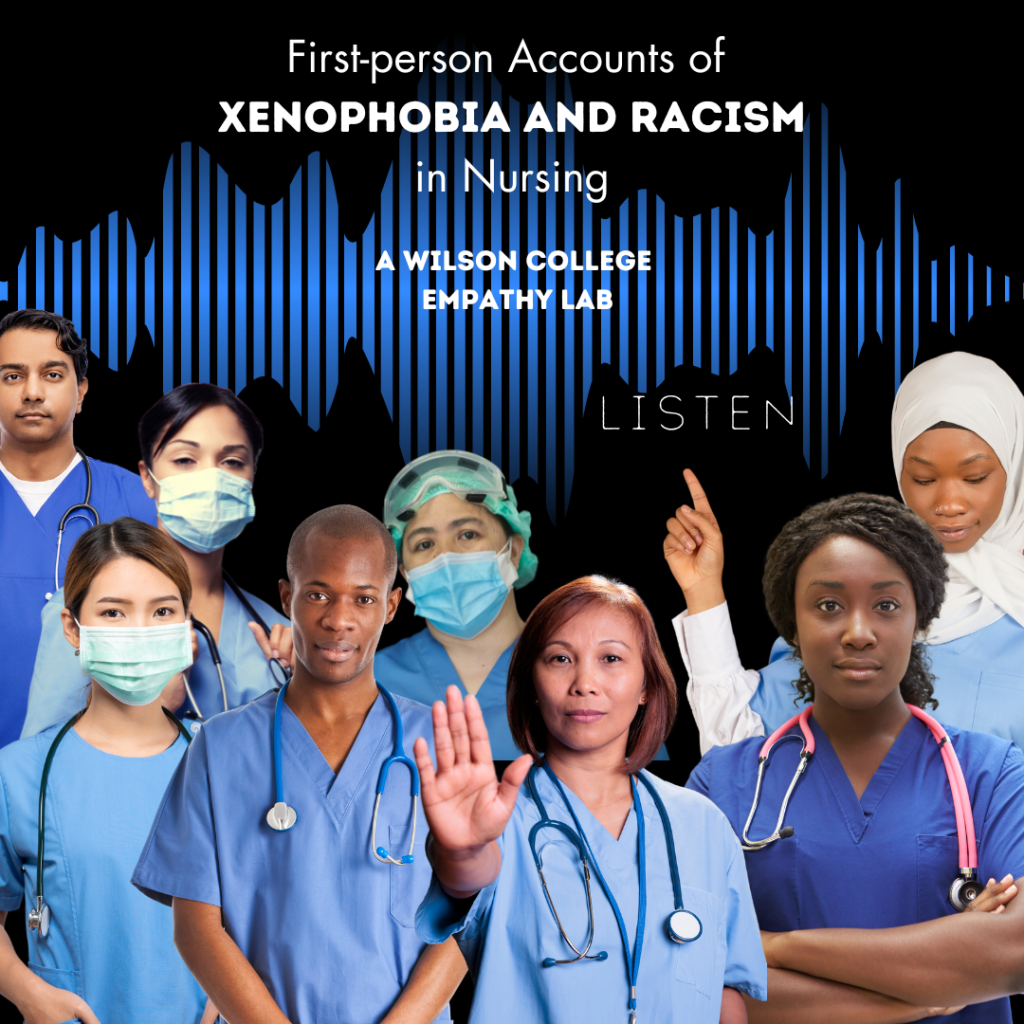

If you are a nurse of color, an international nurse, or a nurse of multicultural background who has experienced discrimination or xenophobia in your workplace and would like to share your story with us, please click the button above to be taken to our Google form where you will be able to submit your narrative anonymously. A volunteer from The UnCenter will read and audio record your story for our Empathy Lab, which will launch February 12, 2024, both in person and here on our website, ensuring its reach to a wider audience.
This initiative represents the first of what will become an online repository, which will serve as a digital archive of nurses’ narratives. We would be so grateful for your contribution to this important project.
Read our offical letter of invitation → here.
See a preview of the submission form below. ↓↓↓
Preview of the Google Form for Nurse Contributors (linked above “Submit Your Story Here”)


The Empathy Lab
TOOLKIT (➜ Click here to enter).
As a nurse of color, I …
“As a nurse of color, I face obstacles that involve my physical appearance, education, intelligence, speech, body language, thought processes and more. All nurses show up for work to provide high-quality patient care. However, a nurse of color has to pack extra information baggage to prepare for the environment surrounding them while providing the necessary care for their patients.
I have to worry if my patients are getting what they need and if I’m perceived by my peers the way I intended. I fear that my high education will intimate my peers and leaders to the point of inferiority. Is my hair professional enough? Do I come off as intelligent or am I viewed as a braggart? Did I respond with a proper tone and smile so they won’t see me as the aggressive Black woman? I have an idea for process improvement, but should I mention it or do I keep quiet since I have a history of white leaders stealing my thoughts and taking credit for them?
Yet, throughout the struggle, my main goal is to work collaboratively with all races and deliver care that produces optimal patient outcomes.”
Deanna Stewart, DNP, RN. Health Services Manager at Optum Healthcare’s Landmark Health (Huntington Beach, Calif.) and Founder of nonprofit MyALLy Stewart Diversity Consulting (Clayton, N.C.)
Source:
Dean, Bari Faye. “What Nurses of Color Want White Nurses to know” Www.beckershospitalreview.com, 20 June 2023, http://www.beckershospitalreview.com/nursing/what-nurses-of-color-want-white-nurses-to-know-we-dont-trust-you-and-we-dont-have-to-2.html.

STATISTICS
Results from the 2022 comprehensive survey of over 5,600 nurses conducted by the National Commission to Address Racism in Nursing reveal the rampant racism that continues to plague the nursing field. Most disturbing among the findings is that racist acts are committed primarily by coworkers and by those in positions of power. “Over half (63%) of nurses surveyed say that they have personally experienced an act of racism in the workplace with the transgressors being either a peer (66%) or a manager or supervisor (60%).”
Below are some key findings from a Robert Wood Foundation Survey conducted this year involving 980 nurses providing further insight into the discrimination nurses experience at work:
- Almost 8 out of 10 nurses have seen or experienced racism/discrimination from patients, and almost 6 out of 10 nurses said the same about racism/discrimination from colleagues (6).
- Of nurses who’ve seen or experienced racism or discrimination in the workplace, 9 in 10 nurses say it has affected their mental health/well-being (11).
- 2 in 3 nurses have been or experienced microaggressions from patients due to race/ethnicity, and nearly half (47%) of nurses said the same about microaggressions from colleagues. (13)
- Fewer than 1 in 4 nurses formally reported racism/discrimination they saw or experienced to workplace management (15).
“2 in 3 nurses have been or experienced microaggressions from patients due to race/ethnicity, and nearly half (47%) of nurses said the same about microaggressions from colleagues.” (13)
“Insights into Nurses’ Experiences and Perceptions of Discrimination” Robert Wood Foundation Survey (May 2023)
Racial microaggressions are (1) verbal and non-verbal assaults directed toward People of Color , often carried out in subtle automatic, or unconscious forms; (2) layered assaults, based on race and its intersections with gender, class, sexuality, language, immigration status, phenotype, accent, or surname; and (3) cumulative assaults that take a psychological, physiological, and academic toll on People of Color” (298).
Source: Pérez Huber, Lindsay, and Daniel G. Solorzano. “Racial microaggressions as a tool for critical race research.” Race Ethnicity and Education 18.3 (2015): 297-320.
POLLS
Your participation in these polls is anonymous and completely voluntary. We will share the results of these polls at the end of our Empathy Lab in February. Keep in mind that this poll is designed for informational and educational purposes only. The responses gathered will be used to enhance understanding and further discussion on these topics but will not be employed in any formal or official capacity. Please do not participate if you are not genuinely interested in contributing honest answers to this important conversation. We are grateful for your participation!
The Empathy Lab
TOOLKIT (➜ Click here to enter).
 THE UNCENTER