

WELCOME
Welcome to the Spring 2024 Empathy Lab, a transformative space for both virtual and in-person participants to engage with the realities of nurses who experience racial discrimination and xenophobia in the workplace. Within the Lab and Toolkit, you will find the following:
- a guide to Active Listening,
- an introduction to the concept Cultural Humility,
- access to the Nurses’ narratives (☎️ audio and full transcript),
- opportunities to respond to the narratives through guided reflection and voice messaging and our collaborative whiteboard activity using Google Jamboard
- a feedback survey for lab participants
The kit closes out with tips for allyship to carry the insights gained through the lab into a more just and equitable future. We are grateful for your presence and participation in this meaningful exploration.
Table of Contents
- WELCOME
- Table of Contents
- Note:
- Content Warning
- Guide to Active Listening
- Cultural Humility
- A Guide to Non-Verbal Communication
- Listen to the Stories
- EMPATHY LAB ACTIVITIES
- GUIDE for RESPONSES (PRE-LISTENING)
- CONNECT TO JAMBOARD (POST-LISTENING)
- PARTICIPANT FEEDBACK (POST-LAB)
- Transcripts of the Narratives
- ALLYSHIP
Note:
A note before you jump in: there are a lot of parts to this lab, so you may want to explore first and see what’s going on here to get your bearings. Take your time, look around, read, think, write, feel… You are welcome to do the lab in one sitting or come back several times—however feels right for you.
Our empathy lab toolkit is intentionally designed with a vertical scrolling layout to foster an immersive learning experience. This approach allows participants to read through crucial content while also encouraging a continuous flow of information and reflection. As you scroll, you’ll encounter a few links that open in new tabs, offering deeper dives into specific topics. This design choice supports our commitment to holding the space for focus and exploration within the lab, guiding the path through important material before inviting you to engage further with our Nursing Narratives.
PART ONE: Preparing to Listen
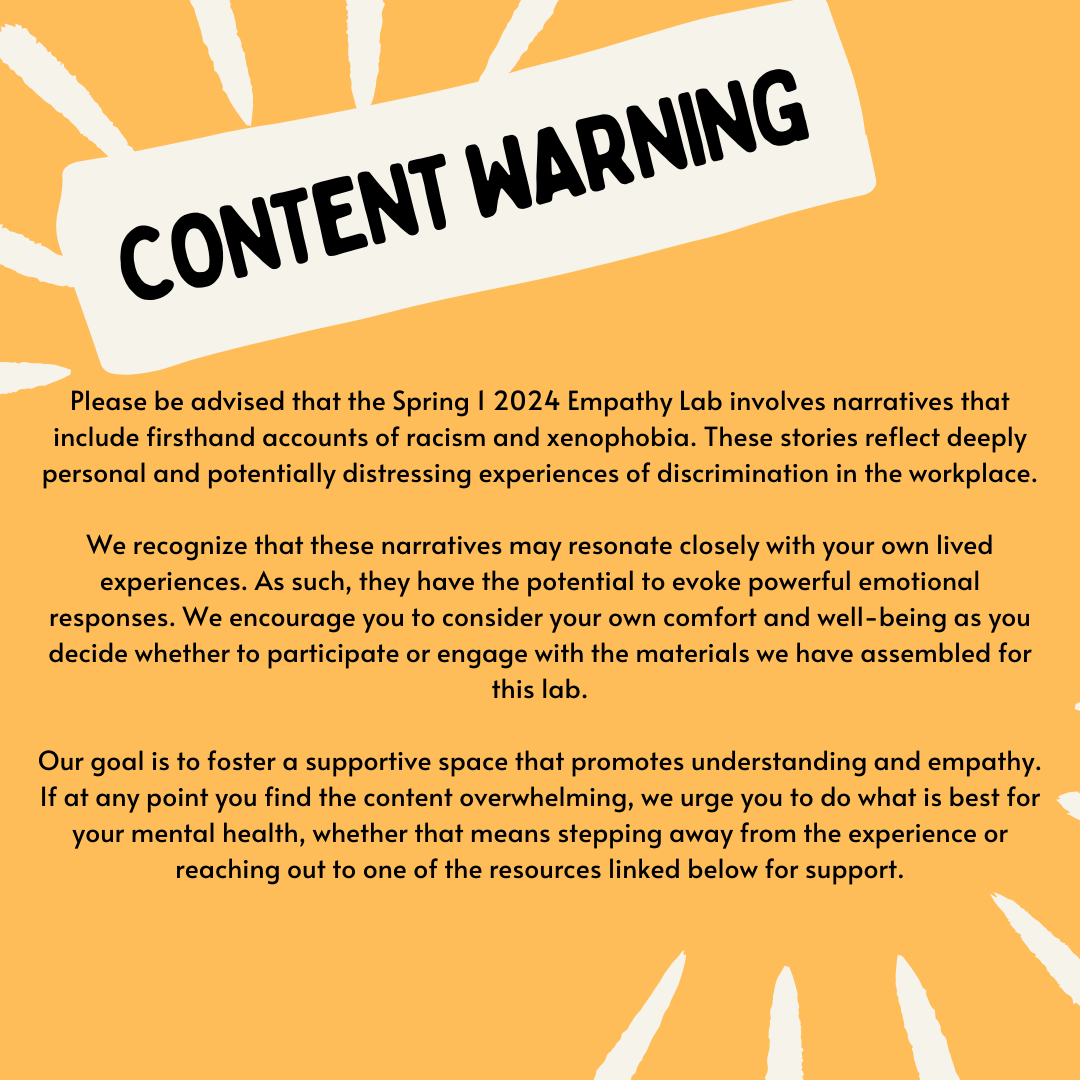
Content Warning
Guide to Active Listening

Cultural Humility

Cultural humility is an approach to engagement across cultures that emphasizes self-reflection and critique after one recognizes and challenges power imbalances. It is about lifelong learning and critical self-reflection, recognizing and mitigating power imbalances, and developing and maintaining respectful partnerships based on mutual trust.
Unlike cultural competence, which suggests a final state of knowledge or mastery of another’s culture, cultural humility is a process focused on self-humility and awareness of how one’s own culture impacts interactions and perceptions. It requires an acknowledgment that an individual cannot possibly know everything about other cultures and that understanding is a continual growth process.
Cultural humility is particularly important in healthcare, where practitioners regularly interact with persons from diverse cultural backgrounds and where there are significant power dynamics at play.


A Guide to Non-Verbal Communication
PART TWO: LISTENING

Listen to the Stories
🛑 Before you dial: Please be sure to read through the “Guide for Responses” (in the yellow box below). You will want it on hand as you move into the next steps of the lab.
To access the stories, dial: ☎️ 1-717-262-2030 ☎️
EMPATHY LAB ACTIVITIES
GUIDE for RESPONSES (PRE-LISTENING)
Below you will find the link to a script we have prepared to inspire and guide you in responding to the Nurses’ narratives.
CONNECT TO JAMBOARD (POST-LISTENING)
Contribute to our virtual, collaborative whiteboard responding to the prompts we have provided.
PARTICIPANT FEEDBACK (POST-LAB)
Follow the link below to contribute to our exit survey to share your thoughts about our Spring 1 2024 lab.
Transcripts of the Narratives

ALLYSHIP

Ways Empathy Lab participants (of all races, ethnicities, and nationalities) can become effective allies to create a healthcare environment where nurses of color and nurses from culturally diverse backgrounds or other countries feel supported and valued:
- Take the initiative to learn about the historical and current issues that nurses of color and nurses with international or culturally diverse backgrounds face, including systemic racism and xenophobia.
- Actively listen to colleagues of color and multicultural nurses when they share their experiences. Validate these experiences. Do not dismiss, justify, or minimize them. Do not try to explain them away.
- Challenge and speak up against racist or xenophobic remarks, behaviors, or jokes whenever you witness them.
- Advocate for and support policies that promote diversity, equity, and inclusion in the workplace.
- Offer mentorship to nurses of color and international nurses. More experienced nurses can act as sponsors, advocating for their mentees’ career advancement.
- Share information about professional development opportunities, such as conferences, scholarships, and training, especially those aimed at underrepresented groups.
- Support equitable representation in leadership roles for nurses of color and nurses with culturally diverse backgrounds.
- Help create opportunities where nurses can safely discuss issues of racism and xenophobia without fear of judgment or retribution.
- Demonstrate your respect for cultural differences in communication styles, social norms, and healthcare practices.
- Learn to recognize and confront microaggressions, subtle, intentional, and unintentional interactions or behaviors that communicate bias toward historically marginalized groups.
- Regularly check in with nurses of color and nurses from culturally diverse backgrounds to offer support and ask how to better serve as an ally.
- Work collaboratively with nurses of color and international and multicultural nurses to identify issues that affect them and to develop practical solutions.
- Amplify the voices of nurses of color and multicultural and international nurses in meetings and discussions, ensuring they are heard, and their ideas considered.
- If you have privilege, reflect on it, and use it to advocate for colleagues who do not have the same level of influence or who may be marginalized.
- Learn to correctly pronounce the names of coworkers! Pronouncing a person’s name is a fundamental indication of respect and acknowledgment of their identity.
- Show appreciation and respect for the diversity that nurses of color and international nurses bring to the team.
 THE UNCENTER